

Table of Contents
- What Is the Frontier Program?
- Frontier Agents in Microsoft 365 Copilot
- Microsoft Agent 365: The Control Plane Behind Frontier Agents
- The Role of Frontier Agents in Enterprise Transformation
- Examples of Frontier Experiences Available Today
- How Administrators Enable and Manage Frontier Agents
- Why Frontier Agents Matter for Enterprise Architects
- Conclusion
Summary Lede
Microsoft Frontier Agents represent a fundamental shift in enterprise automation, moving from rigid rule-based systems to reasoning-capable AI agents that can gather information across organizational boundaries, synthesize complex data, and execute multi-step workflows autonomously. By operating within your existing Microsoft 365 infrastructure and security frameworks, Frontier Agents enable organizations to reimagine how work gets accomplished without requiring separate governance infrastructure or bypassing compliance controls.
Read on, if you are an enterprise architect, IT administrator, or business leader evaluating how to incorporate AI-based reasoning and automation into your organization, this article provides the technical and strategic foundation you need to understand what Frontier Agents actually do, how they differ from traditional automation approaches, and what you should consider before implementing them. You will learn the specific capabilities of Frontier Agents, the governance mechanisms that control them, and the workflow redesign required to realize genuine value - not just the technology deployment itself. Whether you are preparing to participate in the Frontier program or evaluating whether agent-based automation makes sense for your organization, this deep technical overview will help you make more informed decisions about where and how to invest in this emerging technology.
What Is the Frontier Program?
The Frontier program provides organizations with a structured mechanism to participate in early evaluation of emerging artificial intelligence capabilities within their existing Microsoft 365 infrastructure. Rather than deploying untested features across production systems, Frontier allows selected teams and administrators within an organization to voluntarily work with experimental AI features in a contained manner. These experimental features include various types of AI-powered agent systems - software entities capable of autonomous or semi-autonomous reasoning and action - as well as extensions to the Copilot assistant interface and specialized agent modes tailored for specific applications. Importantly, all of these experimental capabilities operate within the same security and data boundaries as the organization’s regular production Microsoft 365 environment. This design ensures that experimental features automatically inherit the organization’s established security policies, identity and access management through Entra ID, data location requirements, and compliance obligations. Organizations do not need to build separate infrastructure or bypass their existing governance frameworks to participate in these early evaluations.
Key characteristics of the Frontier program include:
- Native Tenant Integration: Frontier agents operate seamlessly within your existing Microsoft 365 tenant, leveraging established security postures, Entra ID identity controls, data residency requirements, and compliance frameworks without requiring separate infrastructure or governance bypass.
- Controlled Experimental Access: Organizations can grant selective access to preview capabilities through granular admin controls, ensuring that experimental features remain isolated to designated teams while maintaining full visibility and auditability.
- Feedback-Driven Iteration: Microsoft actively incorporates operational data and user insights to refine, enhance, or retire Frontier capabilities, creating a responsive feedback loop that shapes agent behavior and feature maturity.
- Licensing and Activation Requirements: Access to Frontier agents typically requires valid Microsoft 365 and Microsoft 365 Copilot licenses, with explicit administrator enablement through the Microsoft 365 Admin Center to control program participation at the organizational level.
Frontier Agents in Microsoft 365 Copilot
What Are Frontier Agents?
Frontier Agents are software systems that are built directly into Microsoft 365 applications and the Copilot experience. These systems work by gathering information from across your organization, analyzing it step by step using logical reasoning, and then executing tasks that require multiple sequential steps.
When you interact with a Frontier Agent, here is what actually happens beneath the surface: The agent first receives some information or a request from you. It then searches and retrieves data from various sources across your organization, including your emails, stored documents, calendar entries, meeting transcripts, and other business systems. Rather than simply retrieving information through a traditional search, the agent analyzes and reasons with the information it has gathered. It considers how different data elements relate to one another, understands the context in which that data exists, and then breaks down your original request into smaller, sequential steps that it can execute.
Two concrete examples of Frontier Agents currently available are the Researcher and Analyst agents. The Researcher agent, for instance, can accept a specific question from you and then search through the documents, emails, and other sources available within your organization to locate relevant information. After gathering this information, it synthesizes the pieces to provide a comprehensive answer to your question. The Analyst agent operates on similar principles but is designed to examine data from multiple sources and identify patterns, trends, or themes that emerge across that data, rather than being built to answer a specific user question.
An important distinction to note is that these agents are not limited to a single predefined action. Rather, they can take a single complex request from a user - such as “prepare a written summary of all customer feedback that arrived via email during the last quarter” - and break it down into multiple sequential steps. The agent might begin by identifying which emails and documents actually contain customer feedback. Following that, it might classify the feedback into categories by topic or theme. After categorization, it would extract the most significant points from each category. Finally, it would compile all of this into a single coherent summary document. Instead of a human staff member manually executing each step in sequence, the agent can reason through the problem and execute them in a logical order.
Real-World Scenarios
To better understand how these agents function in practical situations, consider the following concrete examples of work that they can perform:
-
Analyzing customer feedback across multiple communication channels: Organizations receive customer feedback through various channels - email messages, support tickets, conversation logs, and direct messages. Rather than having a team member manually review months of accumulated customer communications to identify recurring problems, an agent can systematically examine all these disparate sources of customer input across your organization, identify which specific issues or concerns appear multiple times, and surface those recurring themes for leadership. This process would otherwise require significant manual effort to collate information from systems that were never designed to be analyzed together.
-
Constructing comprehensive business review documents by synthesizing information from heterogeneous sources: Businesses often need to prepare periodic review documents that combine information from multiple different places - strategic documents that were written and stored in your document systems, records of what was discussed and decided during meetings throughout the review period, and email conversations where important decisions and discussions occurred. An agent can gather these distinct types of information across different systems and synthesize them into a coherent narrative that presents a unified view of what occurred during the period in question.
-
Locating decision points that remain unresolved in organizational communications: In any organization, communications - whether through email, chat systems, or meeting notes - often contain discussion about decisions that need to be made, but the outcome of those discussions remains unclear or incomplete. An agent can review your organization’s communications, identify discussions where no clear resolution was documented, and compile a summary that clarifies which decisions remain pending and who should be involved in resolving them.
-
Evaluating patterns in historical meeting content and suggesting corresponding workflow adjustments: Organizations hold many meetings over time, and the topics, themes, and concerns that emerge across multiple meetings often reveal something meaningful about where real work challenges lie. An agent can review the captured records from your organization’s past meetings, identify recurring themes and concerns across meetings and groups, and use that analysis to suggest where the organization might redirect its focus or restructure its processes to address the underlying issues that keep arising.
Microsoft Agent 365: The Control Plane Behind Frontier Agents
Agent 365 is the administrative and governance layer that supports AI agents across an enterprise.
Key Capabilities
-
Agent Discovery and Inventory Management: Agent 365 maintains a comprehensive record and catalog of all AI agents operating within an organization. This inventory function allows administrators and operators to understand which agents exist, where they are deployed, what purposes they serve, and their operational status at any given time. Rather than having agents scattered across the organization with no central visibility, this inventory system provides a unified view of the agent ecosystem.
-
Identity-Based Resource Access Controls: Agent 365 works in conjunction with Entra ID (Azure’s identity management system) to establish which specific resources, data sources, and systems that individual agents are allowed to access. Instead of granting agents unlimited access across an organization’s systems, Agent 365 enforces granular permission boundaries, ensuring each agent can access only the data, applications, and services necessary to perform their assigned functions. This principle of least privilege prevents an agent from inadvertently or maliciously accessing sensitive data or systems outside its defined scope.
-
Standardized Integration Interfaces and Development Kits: Agent 365 provides standardized software development kits (SDKs) and application programming interfaces (APIs) that establish consistent patterns for how new agents can be built and integrated with existing organizational systems. Rather than building each agent in isolation using different approaches, these standardized interfaces ensure that agents built by different teams or vendors can work together and communicate in predictable ways, following established patterns.
-
Relationship Mapping and System Visualization: Agent 365 provides administrators and architects with visual representations that illustrate how different agents relate to one another, how they connect to and interact with people in the organization, what data sources they access or modify, and how they fit into broader business workflows. This visualization capability helps organizations understand the dependencies and interactions across their entire agent estate.
-
Integrated Security Operations and Threat Detection: Agent 365 incorporates monitoring and alerting functions that work in coordination with Microsoft Defender (security threat detection) and Microsoft Purview (data governance and compliance). This integration enables security teams to monitor agent behavior for signs of anomalous or suspicious activity and compliance teams to track whether agents are handling regulated data appropriately.
-
SDK Components and Development Framework Support: Agent 365 supplies developers with pre-built components, software libraries, and reference implementations that accelerate the process of creating new agents or extending existing ones. It also supports industry-standard protocols, such as the Model Context Protocol (MCP), which establishes common patterns for how components can exchange information and coordinate their behavior.
The Role of Frontier Agents in Enterprise Transformation
As organizations implement Frontier Agents, they are fundamentally reconsidering how work gets accomplished. Rather than viewing these systems as replacements for human workers, the most effective deployments treat agents as tools that handle specific, well-defined operational tasks while people focus on decision-making, judgment calls, and work that requires contextual understanding.
This shift requires more than simply enabling a new technology. Organizations need to redesign their operational workflows to leverage agents’ capabilities. This means identifying which portions of existing processes are primarily repetitive information gathering, data synthesis, or sequential task execution - the kinds of work that agents handle effectively - and then separating those portions from the work that genuinely requires human judgment, client interaction, or strategic thinking. Once this separation occurs, you can structure a workflow where the agent handles the mechanical portions while a person reviews and takes responsibility for the decisions that matter.
One practical implication worth considering: when an agent executes multiple steps in sequence to complete a task, there are often opportunities to build in checkpoints that allow a human to review the agent’s work before it moves to the next stage. This prevents compounding errors and allows people to correct the agent’s reasoning when it goes astray. Rather than treating agent output as completely reliable or completely unreliable, organizations learn to understand where agents tend to make mistakes and design their approval workflows accordingly.
Another important consideration is that moving work to agents does not necessarily mean work disappears from the organization. Instead, the work’s character changes. Where someone previously spent time reading through emails to find relevant information, they now spend time reviewing the agent’s findings to verify that the needed information was captured. Where someone previously spent time copying data from one system into a report, they now spend time checking whether the agent’s synthesis of that data makes sense. This redistribution of work can free up capacity for higher-value activities, but only if organizations deliberately redirect that freed-up capacity toward them rather than simply eliminating positions and expecting the same output from fewer people.
Examples of Frontier Experiences Available Today
The Frontier ecosystem includes:
- Experimental Copilot agents in the Agent Store.
- Agent Mode in Excel for the web.
- Agents for Dynamics 365 workloads.
- Experimental functionalities in Word, PowerPoint, and Copilot Chat.
- AI-enhanced Windows 365 Cloud PC capabilities.
How Administrators Enable and Manage Frontier Agents
Administrators must:
- Confirm licensing prerequisites.
-
Enable Frontier in the Admin Center.
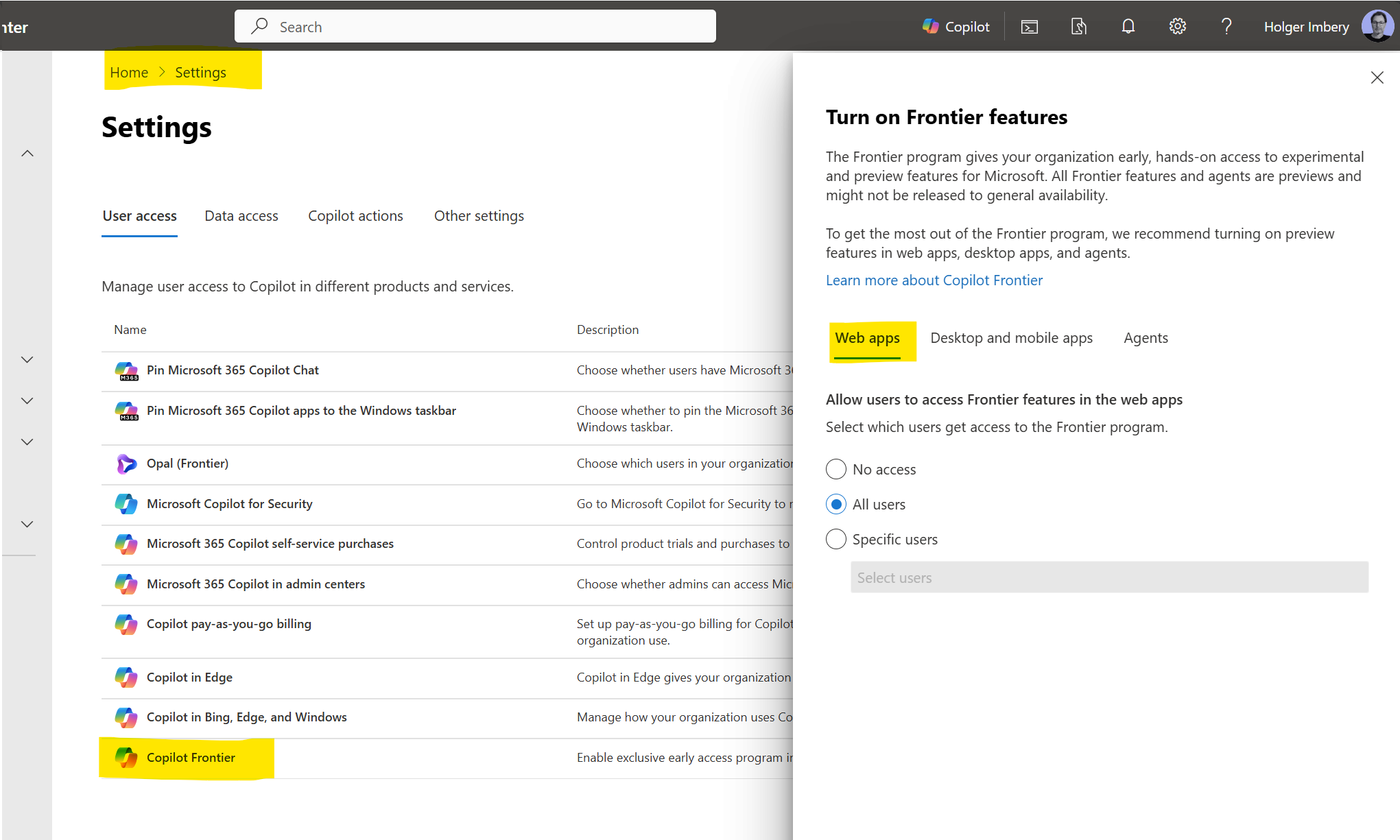
- Assign Frontier access to users.
- Use Agent 365 tools to manage lifecycle, visibility, and compliance.
- Provide SDK access for development.
Why Frontier Agents Matter for Enterprise Architects
Understanding the Shift from Rule-Based to Reasoning-Based Systems
Traditionally, enterprise automation has relied on rule-based systems - tools that follow explicit, predetermined logic written by engineers. These systems work well when the tasks they handle are predictable and straightforward: if condition A is true, then execute action B. However, rule-based systems struggle when circumstances change unexpectedly or when situations don’t fit neatly into predefined categories. When an edge case arises that no one anticipated, the rule-based system either fails or performs the wrong action, requiring human intervention or system modification.
Frontier Agents introduce a different approach. Rather than following rigid if-then-else logic, these agents can examine a situation, understand context and nuance, reason through the problem using information available to them, and adapt their approach as they encounter new information. This capability is critical for enterprise architects because it enables them to automate and streamline work that was previously too variable or context-dependent to automate. Enterprise architects should understand where agents can genuinely improve their organizations and where the investment in agent systems would not yield meaningful returns.
Practical Reasoning Capabilities and Their Implications
Agents can perform multi-step reasoning that mirrors how skilled humans approach complex problems. An agent can gather information from multiple sources, recognize patterns and relationships within that information, adjust its understanding as it discovers new details, and modify its approach based on what it learns. This capability matters for enterprise architects because it changes which business processes become candidates for automation. Instead of limiting automation to straightforward, fixed-sequence tasks, architects can now consider automating substantially more nuanced work. However, architects need to think carefully about which problems benefit from this capability and which would be simpler to solve through other means. Not every situation requires sophisticated reasoning - sometimes simpler solutions serve organizations better.
Unified Governance Without Separate Infrastructure
One of the most significant practical benefits for enterprise architects is that Frontier Agents operate within existing organizational boundaries. Rather than requiring architects to design separate systems, approval processes, or compliance frameworks for agent-based work, agents inherit your organization’s existing security, identity, and compliance structure. This simplifies governance - architects do not need to build parallel systems. However, architects considered how to ensure that existing governance frameworks accommodate agent operations and that identity and access controls properly constrain what agents can do.
Hybrid Human–Agent Workflows and Redesigned Work Processes
Implementing agents require architects and process owners to rethink how work flows through the organization. It is not sufficient to add an agent to an existing workflow. Instead, organizations need to identify where human judgment and decision-making are essential, where human oversight is valuable but not essential, and where mechanical task execution can be delegated entirely to an agent. This often means redesigning workflows substantially. An enterprise architect should expect that workflow redesign will be more challenging and time-consuming than deploying agent technology alone and should budget time and expertise accordingly.
Incremental Adoption and Learning-Based Deployment
Rather than requiring organizations to commit to large-scale transformation immediately, agents can be introduced gradually. This allows organizations to learn how agents affect their work, identify which applications genuinely improve outcomes, develop troubleshooting skills, and build internal expertise. Enterprise architects should view this as an extended learning period in which the organization creates an understanding of what agents can do within their specific context, rather than a one-time implementation that commits the organization to a comprehensive agent-based transformation immediately. This approach carries risks - it means initial projects may not yield dramatic returns - but it also creates space for learning and course correction.
Conclusion
The Frontier program is a practical approach organizations can use to test experimental AI-based systems that perform multi-step reasoning and task execution within their existing Microsoft 365 environments. Rather than requiring organizations to establish entirely separate infrastructure, sign off on different governance frameworks, or bypass critical requirements, the Frontier program enables them to experiment while remaining within their organizations’ existing security and identity boundaries.
Automate Frontier Agents - software systems built into Microsoft 365 applications that gather information from multiple sources, reason with it, and execute sequential tasks to accomplish complex objectives - provides a concrete technology that organizations can use to explore how AI-based reasoning and automation might apply to their own workflows. Agent 365, the administrative layer beneath these agents, provides the inventory management, access controls, monitoring, and coordination mechanisms organizations need to maintain visibility and control over agent operations at scale.
In practice, organizations that choose to implement Frontier Agents will need to do more than enable new technology features. They will need to rethink which parts of their business processes benefit from having agents handle information gathering and task execution, how to structure approval workflows that allow human staff to focus on judgment and decision-making, and how to ensure that the technology actually produces better outcomes rather than simply shifting the character of the work without improving results. This redesign work is often more demanding than the technical implementation itself, but it is also where genuine value is created.
Organizations that approach Frontier Agents as an extended learning opportunity - where initial projects serve as experiments to develop organizational understanding of what agents can accomplish within specific contexts - are likely to make more thoughtful implementation decisions than organizations that pursue large-scale deployment without this learning period. This incremental approach has both benefits and drawbacks: initial projects may not deliver dramatic returns on investment, but the organization will develop practical knowledge of where agents are genuinely helpful, where they create problems, and how to design workflows that leverage agent capabilities effectively.




Start the conversation